Why Agentic AI is Transforming Enterprise Operations
Agentic AI is transforming how organizations operate. Unlike traditional AI systems that respond to user inputs, autonomous agent systems autonomously perceive their environment, set goals, and take continuous actions to achieve measurable outcomes. This comprehensive guide explains what an autonomous system is, how it works, and why 200+ enterprises are already deploying autonomous agents to reduce operational costs by 35-50%.
What You’ll Discover in This Guide
• What agentic AI is and how it differs from traditional systems
• Core capabilities and autonomous decision-making frameworks
• Real-world applications across industries and departments
• Implementation roadmap and technical requirements
• ROI metrics, risk management, and best practices for 2026
Part 1: What is Agentic AI?
Defining Autonomous Intelligence
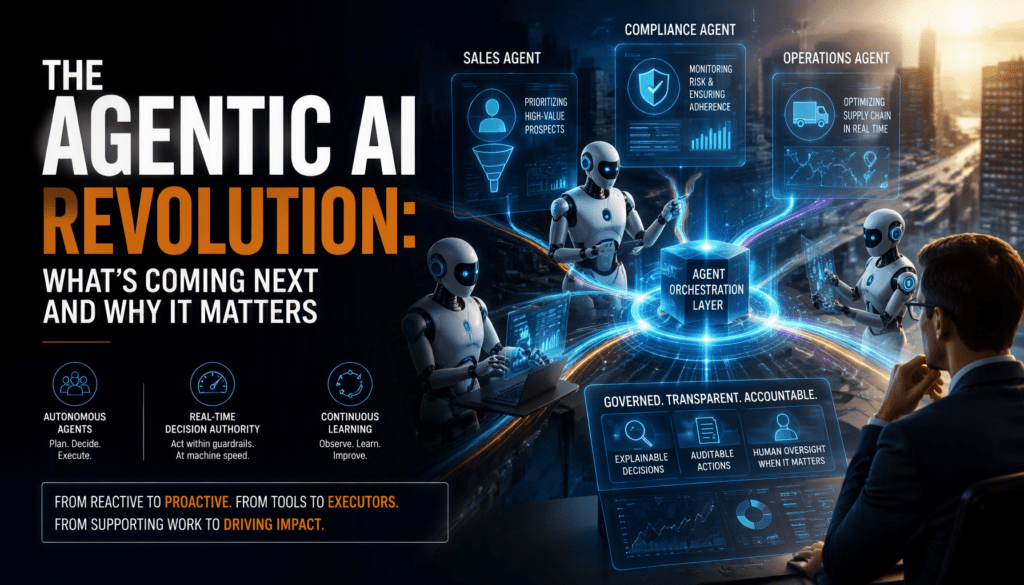
Agentic AI refers to artificial intelligence systems that operate with a degree of autonomy—perceiving their environment, making independent decisions, and taking actions without continuous human intervention. Unlike ChatGPT or traditional ML models that wait for user prompts, agentic AI actively monitors conditions, prioritizes tasks, and executes strategies to accomplish pre-defined business objectives.
Key characteristics of agentic AI:
• Autonomy: Operates independently within defined boundaries
• Goal-Oriented: Works toward measurable business outcomes
• Adaptive: Learns from feedback and adjusts strategies in real-time
• Continuous Operation: Runs 24/7 without human oversight
• Multi-Step Reasoning: Breaks complex problems into sequences of actions
Agentic AI vs. Traditional AI: Key Differences
| Characteristic | Traditional AI | Agentic AI |
| Operation Mode | Reactive—responds to inputs | Proactive—acts autonomously |
| Decision-Making | Single-step, immediate output | Multi-step reasoning with planning |
| Intervention | Requires constant human input | Works independently within guardrails |
| Learning | Static after training | Continuous adaptation and improvement |
| Scalability | Limited by human capacity | Scales exponentially with minimal overhead |
Part 2: Core Capabilities of Agentic AI Systems
- Autonomous Decision-Making
Autonomous capabilities systems evaluate multiple pathways and choose optimal actions based on probabilistic reasoning and historical outcomes. Unlike deterministic algorithms, they navigate uncertainty and prioritize decisions that maximize long-term value.
- Environmental Perception
These systems continuously monitor internal data systems, market conditions, customer behavior, and external signals. They identify patterns and anomalies that trigger autonomous responses, all without human prompting.
- Goal-Oriented Planning
Agentic systems break down business objectives into sub-tasks, create execution plans, and adapt strategies based on real-time feedback. They understand trade-offs and adjust priorities dynamically.
- Tool Integration & API Orchestration
Agentic capabilities systems integrate with existing software, databases, and external APIs. They execute workflows across multiple platforms without manual handoffs or orchestrating complex business processes autonomously.
- Continuous Learning & Adaptation
These systems learn from outcomes, incorporating feedback into future decision-making. They improve over time, becoming more effective and aligned with evolving business needs.
Part 3: Real-World Applications of Agentic AI
- Customer Service & Support
Agentic AI handles customer inquiries, resolves issues autonomously, escalates complex cases to humans, and learns from every interaction. Companies report a 65% reduction in support costs while improving satisfaction scores.
- Sales & Revenue Operations
AI agents identify high-value leads, personalize outreach, track deal progress, and predict close dates. They prioritize opportunities and optimize territory assignments in real-time, increasing win rates by 25-40%.
- Supply Chain & Logistics
Autonomous agents optimize inventory levels, forecast demand, manage procurement, and respond to supply disruptions instantly. Organizations see 20-30% reductions in carrying costs and stockouts.
- Finance & Compliance
AI agents monitor transactions, detect fraud patterns, manage regulatory reporting, and reconcile accounts autonomously. They flag anomalies and ensure compliance without human delays.
- Marketing & Campaign Optimization
Autonomous AI systems test creative variations, optimize ad spend, personalize messaging, and adjust campaigns in real-time based on performance. Expected ROI improvements: 40-60%.
- Software Development & QA
AI agents write code, run tests, identify bugs, and suggest optimizations autonomously. Developer productivity increases 35-50% with agentic AI assistance in the development pipeline.
Case Study: How TechCorp Automated 40% of Operations with Agentic AI
TechCorp, a B2B SaaS company with 500+ employees, deployed Autonomous capabilities across customer success, finance, and operations in 6 months.
Implementation:
• Deployed AI agents for customer onboarding and renewal management
• Automated invoice processing and vendor payment workflows
• Created AI-driven demand forecasting for product roadmapping
• Integrated agents with Salesforce, NetSuite, and Slack for real-time operations
Results (12 months):
• 40% reduction in manual operational work
• $2.1M annual cost savings from process automation
• 28% improvement in customer retention through proactive AI engagement
• Forecasting accuracy improved from 72% to 91%
• Team capacity freed up for strategic initiatives instead of manual tasks
Part 4: Implementing Agentic AI in Your Organization
Step 1: Identify High-Impact Use Cases (Weeks 1-3)
Start with processes that are repetitive, data-intensive, and high value. Map current workflows and identify bottlenecks where agentic AI can reduce friction. Target 2-3 pilot use cases with potential 30%+ efficiency gains.
Step 2: Assess Data Infrastructure (Weeks 4-6)
Agentic AI requires clean, accessible data. Audit your data quality, integration capabilities, and API availability. Prepare your tech stack for agent integration (Salesforce, ERP systems, databases, etc.).
Step 3: Select the Right AI Platform (Weeks 7-10)
Agentic AI requires clean, accessible data. Audit your data quality, integration capabilities, and API availability. Prepare your tech stack for agent integration (Salesforce, ERP systems, databases, etc.).
Choose between enterprise AI platforms (Anthropic’s Claude agents, OpenAI Assistants, Salesforce Agentforce) or open-source frameworks (LangGraph, AutoGen). Evaluate based on your technical team’s capabilities and integration needs.
Step 4: Build Guardrails & Safety Measures (Weeks 11-14)
Define decision boundaries, approval thresholds, and escalation rules. Implement audit trails, consent management, and monitoring systems to ensure agents stay within acceptable parameters.
Step 5: Deploy & Monitor (Weeks 15-20)
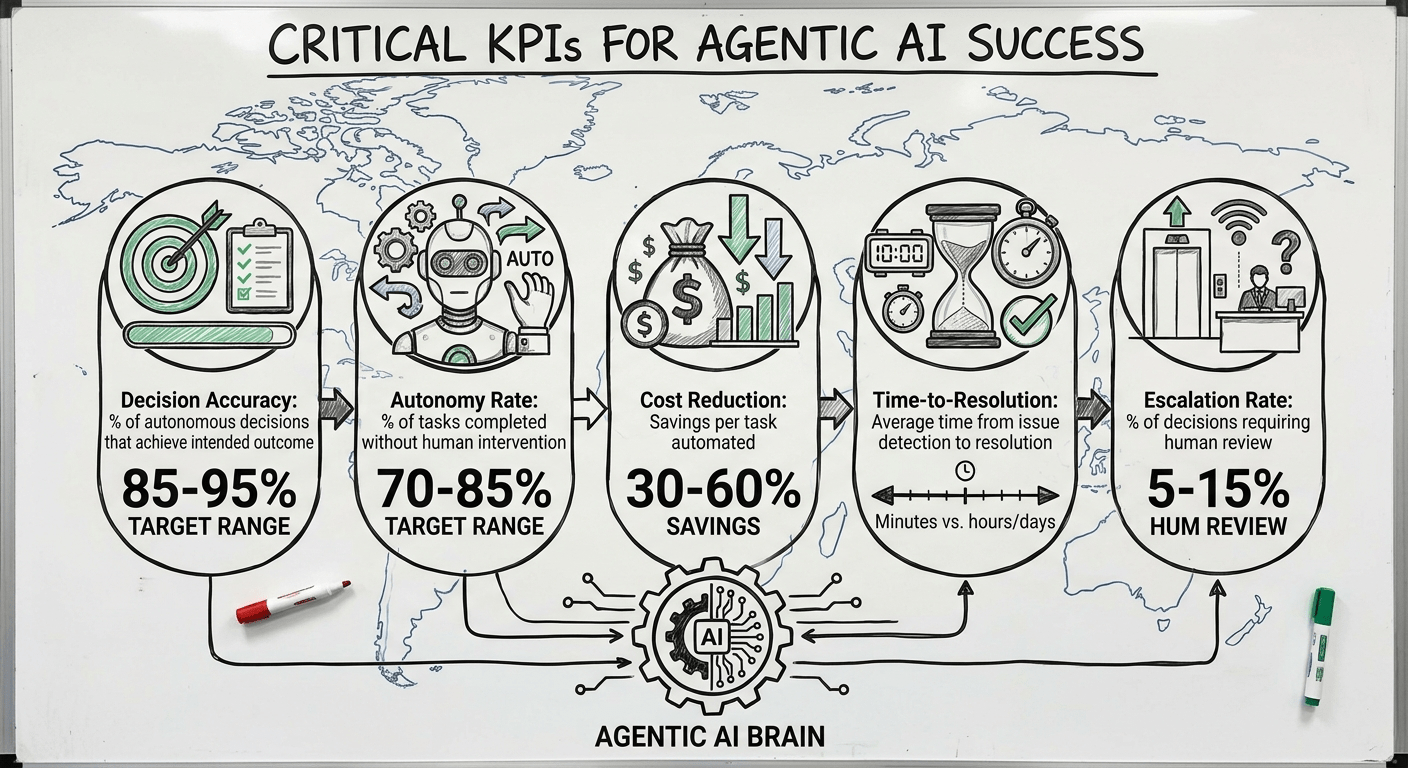
Start with limited deployments. Track KPIs, monitor decision quality, gather feedback, and iterate. Gradually expand agent autonomy as confidence increases and performance validates assumptions.
Step 6: Scale & Optimize (Months 6+)
Once pilots prove value, expand to other departments and use cases. Standardize agent design patterns, centralize training data, and create an Autonomous Agents Center of Excellence.
Critical KPIs for Agentic AI Success
Managing Risk in Agentic AI Deployments
- Hallucination & False Confidence
AI agents may generate plausible-sounding but incorrect outputs. Mitigation: Implement fact-checking mechanisms, require verification for high-stakes decisions, and maintain audit trails of all agent reasoning.
- Alignment & Goal Drift
Agents might pursue unintended goals or optimize for the wrong metrics. Solution: Define clear, measurable objectives; implement reward mechanisms; monitor for unintended behaviors; adjust goals quarterly.
- Data Privacy & Security
Autonomous agent systems access sensitive data. Ensure GDPR/CCPA compliance, encrypt data in transit and at rest, implement role-based access controls, and maintain compliance logs.
Frequently Asked Questions About Agentic AI
Q: What’s the difference between agentic AI and AI automation?
AI automation executes predetermined workflows—if X happens, do Y. AI agents are more sophisticated: they perceive environments, set priorities, make adaptive decisions, and adjust strategies based on feedback. Automation is rule-based; AI agents are goal-based and learn continuously.
Q: Is agentic AI the same as AGI (Artificial General Intelligence)?
No. AGI is hypothetical AI that matches or exceeds human intelligence across all domains. Autonomous systems today are narrow—they excel at specific tasks within defined domains. They’re autonomous within their domain but lack AGI’s general reasoning abilities.
Q: How long does it take to implement AI agents?
Pilot deployments typically take 4-6 months. Full organizational rollout takes 12-18 months. Timeline depends on data readiness, technical infrastructure, use case complexity, and change management maturity. Quick wins are possible in weeks; mature programs take years to optimize fully.
Q: What’s the typical investment required for agentic AI?
Budget varies by scale. SMBs typically spend $100k-$500k for pilot programs. Mid-market enterprises spend $500k-$2M. Large enterprises invest $2M-$10M+. Include software licenses, integration work, training, and change management. Most organizations see ROI within 12-18 months.
Q: Can we use agentic AI without extensive data science expertise?
Modern agentic AI platforms (Claude agents, Salesforce Agentforce, Microsoft Copilot) abstract much of the complexity. Non-technical business users can configure agents with minimal coding. However, optimal results still benefit from data engineering and ML expertise, especially for complex orchestrations.
Q: What industries benefit most from AI agents?
Agentic AI delivers the fastest ROI in industries with high-volume, repeatable processes: customer service, e-commerce, financial services, logistics, healthcare administration, and sales. Less suitable for highly creative or deeply regulated work requiring human judgment.
Q: How do we ensure agentic AI systems remain aligned with company values?
Define explicit objectives and constraints during setup. Implement monitoring dashboards tracking agent decisions. Conduct regular audits of high-risk decisions. Maintain escalation paths for boundary cases. Review agent behavior quarterly and adjust prompts/guardrails as needed.
Q: What happens if an agentic AI makes a costly mistake?
This is why guardrails matter. For high-stakes decisions (over $10k, legal implications, customer impact), implement approval thresholds requiring human review. For lower-impact decisions, design rollback mechanisms. Insurance and liability frameworks are evolving—consult legal teams on coverage.
Q: Will agentic AI eliminate jobs?
Intelligent agents automate specific tasks, not entire jobs. Organizations that implement it successfully reassign teams to higher-value work: strategy, customer relations, innovation, and problem-solving. Companies report productivity gains, not headcount reductions. The key is proactive upskilling and change management.
Q: How does agentic AI handle novel, unprecedented situations?
Agentic systems handle novelty through learned patterns and reasoning. If a situation is truly unprecedented, well-designed systems should escalate to humans rather than guess. This is where human oversight remains critical: agents augment human judgment; they don’t replace it.