Agentic AI is artificial intelligence that plans, decides, and acts across multiple steps on its own, instead of waiting for a human to prompt each move. Where a chatbot answers one question at a time, an agentic system can take a goal — “reconcile this month’s invoices” or “book me the cheapest flight that avoids a layover” — break it into steps, use tools and software to carry them out, and adjust when something doesn’t go as planned.
That distinction is why 2026 has become the year “agentic AI” moved from a buzzword to a budget line. Below is what the term actually means, how it differs from the AI most people have already used, what’s changed to make it possible now, where it’s working, where it’s failing, and what to weigh before adopting it.
How This Article Was Put Together
This guide draws on public enterprise-research data from Gartner, McKinsey, IDC, and PwC (cited by name below, with source links), plus general technical documentation on how agent frameworks operate. It does not claim first-hand deployment experience — where a stat or claim needs a real-world implementation case study rather than industry survey data, that’s noted explicitly rather than implied.
Agentic AI vs. Generative AI: The Actual Difference
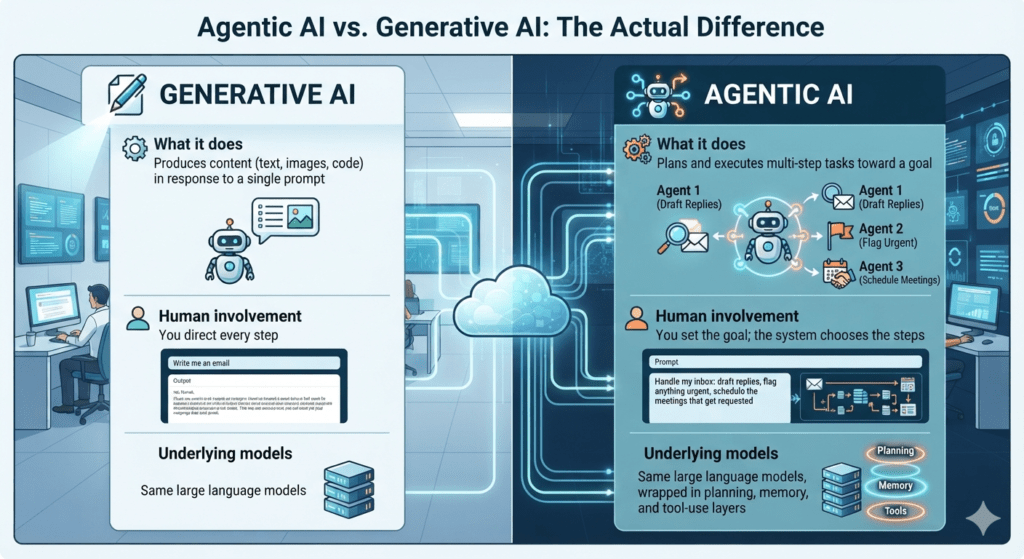
These two terms get used interchangeably, which causes most of the confusion.
| Generative AI | Agentic AI | |
|---|---|---|
| What it does | Produces content (text, images, code) in response to a single prompt | Plans and executes multi-step tasks toward a goal |
| Human involvement | You direct every step | You set the goal; the system chooses the steps |
| Example | “Write me an email” | “Handle my inbox: draft replies, flag anything urgent, schedule the meetings that get requested” |
| Underlying models | Same large language models | Same large language models, wrapped in planning, memory, and tool-use layers |
Agentic AI isn’t a different kind of model — it’s the same generative models given the ability to call tools, remember context across steps, check their own work, and decide what to do next without a person approving each move.
Why Agentic AI Is Happening Now, Not Five Years Ago
Three things had to line up:
- Reasoning got reliable enough to trust with multiple steps. Industry benchmarking cited by Axis Intelligence points to error rates in multi-step agent tasks falling from roughly 8–12% in early 2025 to 3–5% by late 2025 — the range where unattended operation stops being a liability for most business use cases.
- The tooling matured from developer kits to production platforms. Microsoft Copilot Studio, Google Cloud Agent Builder, and Amazon Bedrock Agents moved from “something an engineering team wires together” to “something a business team can configure,” with vendor-reported implementation timelines compressing from months to weeks over the same period.
- Enterprises got comfortable enough to fund it. Digitalapplied’s 2026 statistics roundup finds the global agentic AI market growing well over 40% annually, and Gartner projects 40% of enterprise applications will embed task-specific agents by the end of 2026, up from under 5% in 2025.
Where Adoption Actually Stands in 2026
This is the part most coverage skips, and it matters more than the growth numbers alone: adoption and production use are not the same thing.
- McKinsey’s 2025 State of AI research found 88% of organizations use AI in at least one business function — but only 23% are scaling agentic AI anywhere in the enterprise.
- Digitalapplied’s 2026 data collection describes this as a “79% adoption vs. 11% production gap”: nearly four in five enterprises have adopted AI agents in some form, but only about one in nine runs them in production.
- IDC research cited by Unicoconnect found 88% of AI proofs-of-concept never reach wide-scale deployment.
- Gartner forecasts more than 40% of agentic AI projects will be cancelled by 2027, mostly over unclear business value or inadequate risk controls.
The honest read: agentic AI is real, growing fast, and already changing how some teams work — but most companies experimenting with it right now will not have it running in production a year from now. That’s a normal technology-adoption curve, not a red flag on the technology itself.
What Agentic AI Is Actually Being Used For
Where it’s scaling, per McKinsey’s 2026 research, software development, IT operations, and product engineering lead — domains where tasks are well-defined, tool access is structured, and mistakes are cheap to catch. Healthcare, finance, and the public sector show high interest but slower rollout, largely because errors there carry regulatory or safety weight that flat-out requires more human oversight.
Common early use cases:
- Drafting and triaging routine correspondence
- Reconciling data across systems that don’t talk to each other natively
- Running defined multi-step workflows (onboarding a new employee, processing a return, compiling a weekly report)
- Coding assistance that goes beyond autocomplete into “implement this ticket and open a pull request”
Where Agentic AI Commonly Fails
Worth stating plainly, since most vendor content won’t: PwC’s 2026 CEO Survey of 4,454 executives found only 12% report hitting both revenue gain and cost reduction from AI. The most-cited failure causes across the research aren’t model quality — they’re:
- Unclear business value at the outset (Gartner’s top-cited cancellation reason)
- Weak risk controls for what happens when an agent makes a wrong call
- Data infrastructure that isn’t ready — Axis Intelligence’s research flags this as affecting roughly 47% of organizations attempting deployment
- Underestimating implementation cost — average implementation costs cited in the same research run close to $890,000, well above what many pilots budget for
Should You Adopt Agentic AI? Questions Worth Asking First
- Is the task well-defined enough to hand to a system that won’t ask for clarification mid-task? Ambiguous, judgment-heavy work is a worse early fit than structured, repeatable workflows.
- What happens when it’s wrong? Every agentic deployment needs a defined fallback — a human review step, a rollback path, or both — before it touches anything customer-facing or financial.
- Do you have the data infrastructure to support it? Agents are only as good as their access to clean, current data across the systems they need to touch.
- Is the ROI case specific, or aspirational? Given that cancellations are most often driven by unclear business value, define the metric you’re expecting to move before the pilot starts, not after.
The Bottom Line
Agentic AI is a genuine shift — the same models that write your emails can now be given a goal and trusted to work toward it across several steps. But 2026’s data shows a technology in the messy middle of its adoption curve: real production wins in narrow, well-scoped domains, alongside a large majority of pilots that will stall or get cancelled before they scale. Treat “agentic AI” claims — including the market-growth numbers in this piece — as directional industry research, not guarantees, and weigh any vendor’s pitch against your own data readiness and a clearly defined failure plan.
Frequently Asked Questions
Is agentic AI the same as a chatbot? No. A chatbot responds to prompts one at a time. Agentic AI is given a goal and independently plans and executes the steps to reach it, using tools and software along the way.
Is agentic AI safe to use for financial or healthcare tasks? Adoption in those sectors is real but slower than in software or IT, largely because errors carry regulatory or safety consequences that require tighter human oversight. Most current production use is concentrated in lower-risk, well-defined workflows.
Why do so many agentic AI projects get cancelled? Gartner’s research points to unclear business value and inadequate risk controls as the leading causes — not model performance. Projects that define success metrics and failure handling before launch fare better than those that don’t.