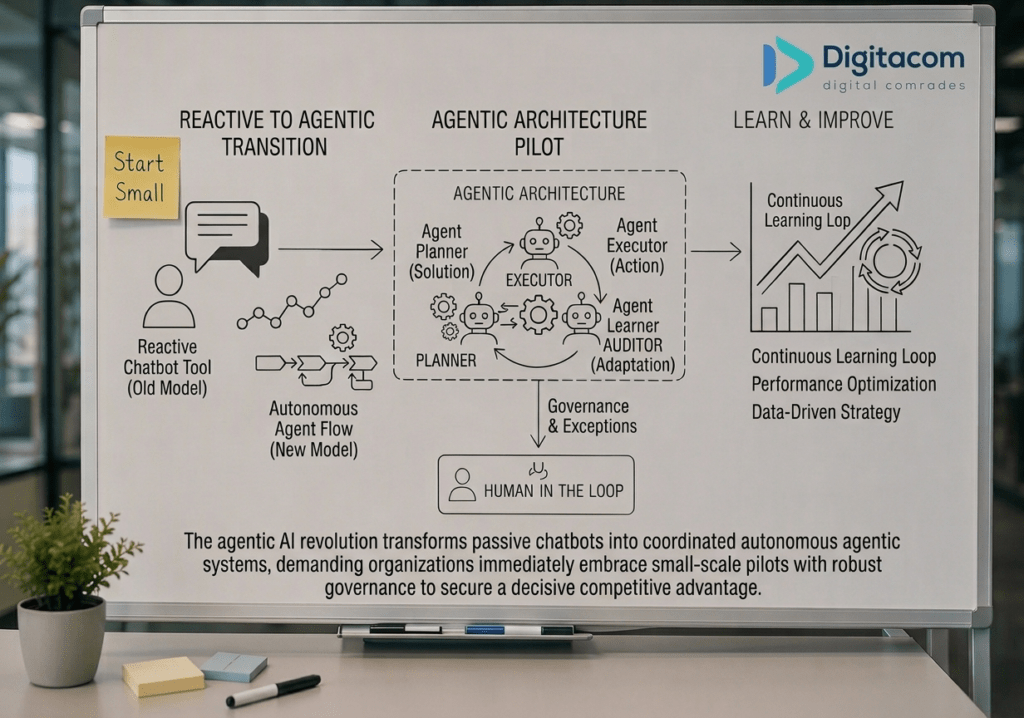
The era of chatbots that answer questions on demand is ending. What’s emerging is agentic Ai far more ambitious: autonomous agents that don’t wait to be asked. They plan, decide and execute, sometimes without human intervention between start and finish.
Agentic AI from reactive AI to agentic AI represents one of the most significant inflection points in enterprise technology. But here’s what most organizations haven’t figured out yet: agentic AI isn’t just a technical upgrade. It’s a fundamental reorganization of how work gets done.
The Shift: How Agentic AI Changes Work
Today’s AI systems are powerful assistants. You prompt them, they respond. It’s a call-and-response model that’s worked well for content generation, coding assistance, and customer service.
Agentic AI flips this dynamic. These systems observe their environment, identify problems, devise solutions, and implement them—all autonomously. A sales agent doesn’t wait for someone to ask it to prioritize leads; it’s already ranking prospects based on pipeline health and engagement signals. A compliance agent doesn’t passively answer questions about regulatory requirements; it’s continuously auditing processes and flagging drift.
As a result, this difference matters because it redefines where human effort goes. Instead of people triggering AI, AI triggers action—and only involves humans when judgment or exception-handling is required
Three Agentic AI Trends Reshaping the Landscape
1. Multi-Agent Collaboration Is the Default
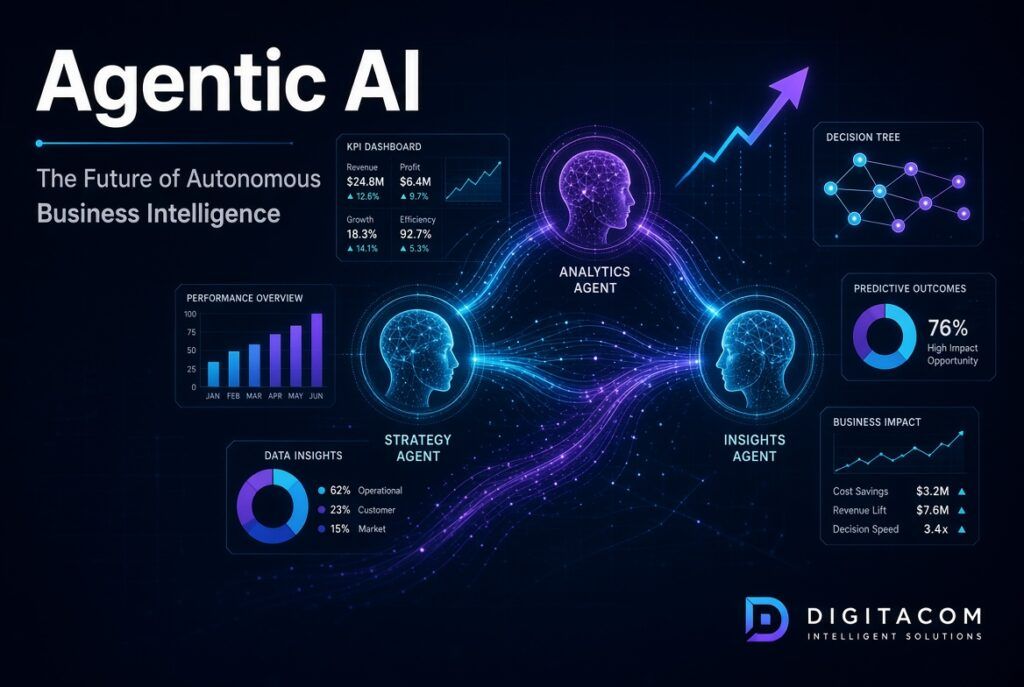
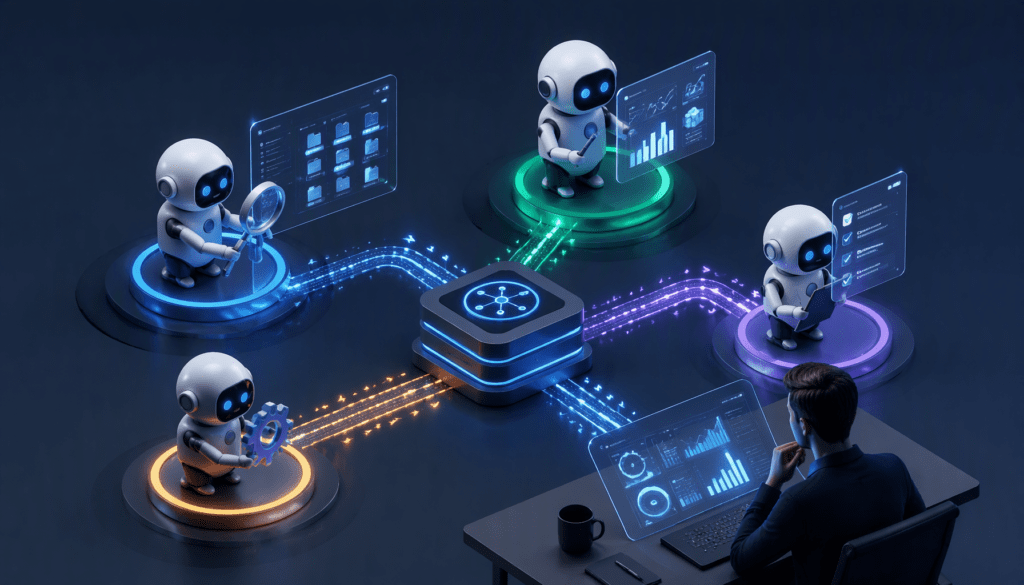
The future isn’t single powerful agents. It’s networks of specialized agents working in parallel and sequence. One agent gathers data. second analyzes it. And a third proposes action. A fourth manages execution. This orchestration model mirrors how complex human teams operate, but at machine speed and scale.
Organizations adopting this approach first are already seeing 3-5x efficiency gains in knowledge work. Furthermore, your competitive advantage will increasingly depend less on hiring brilliant individuals and more on designing agent workflows that amplify human expertise.
2. Real-Time Decision Authority
We’re moving toward a world where agentic systems have delegated decision making authority within bounded domains. Your supply chain agent can reroute shipments to avoid disruption, marketing agent can reallocate budget in real-time based on campaign performance and infrastructure agent can scale resources without waiting for approval.
This isn’t reckless automation. It’s automation with guardrails—agents make decisions within predefined constraints and report outcomes for human review. But the speed advantage is seismic. Decisions that took days now happen in minutes.
The catch? You need mature governance frameworks. Agentic systems that can’t clearly articulate their reasoning become black boxes, and that’s a liability in regulated industries or high-stakes scenarios.
3. Continuous Learning Loops
Static AI systems degrade over time as the world changes. Agentic systems that can observe outcomes, learn from them, and refine their own strategies stay current. An agent that manages customer retention learns which interventions work. It adapts. It improves.
Similarly this introduces a new risk category. agents that overfit to short-term optimization at the expense of long-term health. A customer retention agent that only calls high-churn customers might drive them away further. A cost-reduction agent that cuts training budgets might tank innovation. Continuous learning is powerful only if the optimization targets are right.
The Skills Gap Is Real—and Widening
Here’s what keeps senior technologists awake: there aren’t enough people who know how to design, govern, and maintain agentic systems.
Building with agentic AI requires different mental models than traditional software engineering or even contemporary AI work. You’re reasoning about emergent behavior, designing feedback loops, and architecting systems that gracefully handle ambiguous situations. You’re thinking in workflows and autonomy boundaries, not APIs and databases.
Organizations that start building organizational competency now—through experimentation, hiring, and strategic partnerships—will have 18-24 months of advantage before this becomes table-stakes.
Strategic Questions Every Leader Should Ask
What decisions are candidates for agent automation?
Not everything should be automated. Start with high-frequency, well-defined decisions with clear success metrics. Customer prioritization. Resource allocation. Routine compliance checks. Avoid automating decisions that require deep judgment or carry significant downside risk.
What governance framework do we need?
Agentic systems need oversight mechanisms—audit trails, decision explainability, intervention points. Define these before agents are deployed, not after things go wrong.
Where do we build internal capability vs. buying?
You don’t need to build agentic infrastructure from scratch. more you do need deep expertise in applying it to your domain. This usually means hiring talent and running pilots, not just licensing software.
How do we manage the transition?
Agentic AI will displace some work. Being honest about this and managing it through reskilling, role redesign and transparent conversations—matters more than pretending it won’t happen.
Why the 18-Month Agentic AI Window Matters
Think of it this way: agentic AI is where large language models were in 2022—emerging, powerful, and full of potential. Crucially, the window is still open wide enough that decisions you make now compound massively.
Organizations that treat agentic AI as a distant future concern are already behind. The infrastructure is here. The models exist. What’s missing is organizational readiness: people who understand these systems, governance frameworks that keep them safe, and strategic clarity about what you’re automating and why.
The agent revolution isn’t coming. It’s already starting. The question is ultimately you’re building for it or reacting to it.
The path forward:
Start small. Pick one high-impact, well-scoped workflow. Run a pilot with agentic architecture. That’s how organizations that lead in agentic AI build durable advantage. ultimately of relying on grand proclamations, they achieve it through disciplined experimentation and rapid learning cycles.