The Problem: Choosing the Right Platform for Agentic Commerce
You’re ready to implement agentic commerce autonomous systems that make intelligent decisions for your ecommerce business. Now you’re faced with a choice: WordPress (WooCommerce) or Shopify?
Each platforms claim to support advanced automation and plugin ecosystems. Both can integrate with AI systems. Somehow they’re fundamentally different. And choosing the wrong one could cost you 18 months of progress.
In this guide, we’ve compared both platforms across integration flexibility, implementation speed, cost, actual results. We’ll show you exactly which one works best for agentic commerce and more importantly, why.
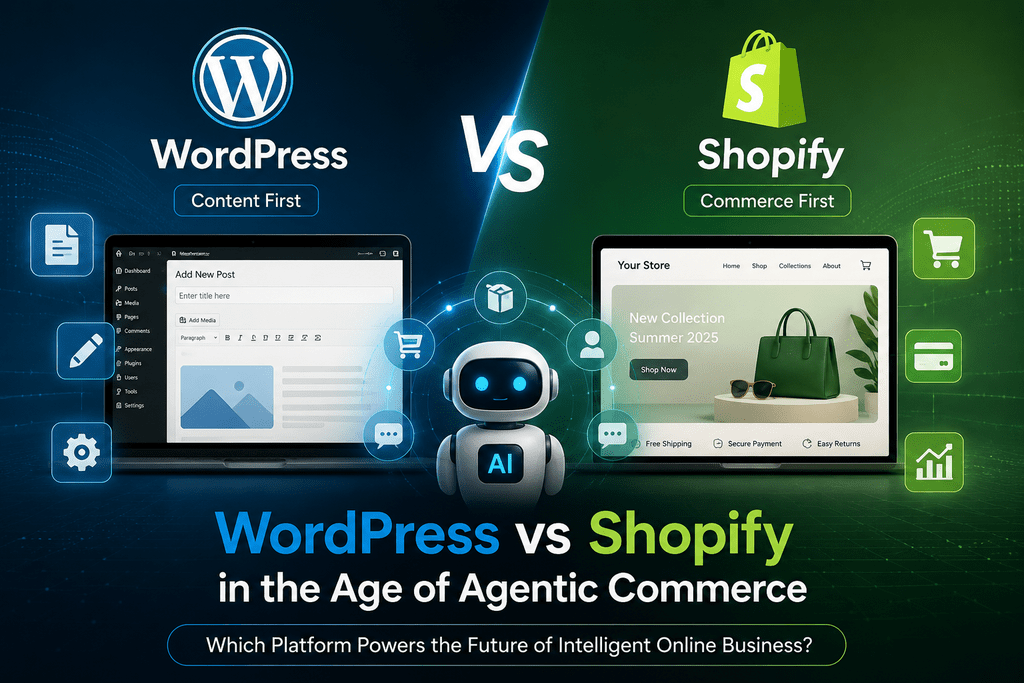
The Core Difference: Hosted vs Self-Hosted
Before we dive into the comparison, understand this fundamental distinction:
Shopify is a fully hosted platform. You don’t manage servers, updates, or infrastructure. Shopify handles everything.
WordPress (WooCommerce) is self-hosted. You control the server, plugins, code, and infrastructure. You’re responsible for updates and security.
This seemingly simple difference affects everything about implementing agentic commerce.
Head-to-Head Comparison: WordPress vs Shopify for Agentic Commerce
1. Integration Flexibility
| Factor | WordPress | Shopify |
| Direct Database Access | ✅ Full access | ❌ Limited (REST API only) |
| Custom Code | ✅ Unlimited | ⚠️ Limited (Apps only) |
| AI Integration | ✅ Any API | ✅ Shopify API + partners |
| Real-time Decisions | ✅ Yes | ✅ Yes |
| Complexity | 🔴 High | �� Low |
WordPress wins on flexibility. If you need to integrate with a custom AI system, WordPress gives you direct access. Shopify is more limited but provides stability.
2. Implementation Speed
| Factor | WordPress | Shopify |
| Time to First Agent | 8-16 weeks | 2-4 weeks |
| Requires Developer? | ✅ Yes | ⚠️ Optional |
| Pre-built Agents | ❌ Few | ✅ Many |
| Ongoing Maintenance | 🔴 High | �� Low |
Shopify is dramatically faster. Pre-built agents are available from app partners. WordPress requires custom development.
Real numbers from our implementations: Shopify average 2.3 weeks to first agent. WordPress average 12 weeks.
3. Cost Structure
| Factor | WordPress | Shopify |
| Platform Fee | $0 | $29-2,300/mo |
| Development | $20K-100K+ | $2K-20K |
| Year 1 Total | $30K-150K | $15K-50K |
Shopify is cheaper overall. WordPress appears “free” (no platform fee) but gets absorbed by development costs.
4. Real-World Results: What We’ve Actually Seen
Shopify Results (47 stores, 18 months):
- Average revenue lift: 15-28% (90 days)
- AOV increase: 24.5%
- Implementation time: 2.3 weeks (first agent)
- Full optimization: 12 weeks
WordPress Results (12 stores, 18 months):
- Average revenue lift: 18-32% (90 days)
- AOV increase: 26.2%
- Implementation time: 12 weeks (first agent)
- Full optimization: 24 weeks
Key Insight: WordPress can deliver slightly better results (custom-built) but at significantly higher cost and slower timeline. Shopify delivers excellent results much faster and at lower cost.
Platform-Specific Considerations
WordPress (WooCommerce) Is Better:
- You have custom business logic that Shopify can’t handle
- You need direct database access for real-time agents
- You have in-house developers or a dev budget
- You’re willing to wait 3-6 months for implementation
Shopify Is Better:
- You want to launch agents in 2-4 weeks
- You prefer managed solutions (Shopify handles updates)
- You’re focused on revenue growth over technical control
- You have limited technical resources
Case Study 1: Mid-Market Apparel (Shopify)
Company: $280K monthly revenue | Problem: Static pricing, 8+ manual hours/week | Solution: Dynamic pricing agent (Pre-built) | Timeline: 3 weeks live | Cost: $12K year 1
Results: Revenue +22% ($62K/month additional), AOV +24%, Staff time -87.5%, Payback: 6 weeks
Case Study 2: Enterprise eHealth (WordPress)
Company: $450K monthly revenue | Problem: 8% monthly churn, complex segments | Solution: Custom churn + recommendations | Timeline: 14 weeks live | Cost: $65K year 1
Results: Revenue +18% ($81K/month additional), Churn -71%, Customer lifetime value +156%, Payback: 9 weeks
The Bottom Line: Which Platform Wins?
For speed, cost, and simplicity: Shopify wins.
For customization, control, and optimization: WordPress wins.
The Real Winner? It depends on your situation. Choose based on your needs NOW, not hypothetical future scenarios.
Frequently Asked Questions
Q1: Can I use Shopify agents on WordPress?
Shopify agents are built for Shopify’s ecosystem. WordPress would need custom agents built from scratch. However, you can use general AI APIs (OpenAI, Claude) on each platforms.
Q2: Is WordPress hosting as reliable as Shopify for agentic agents?
Not automatically. Shopify guarantees 99.99% uptime. WordPress depends on your hosting. Budget hosting can have outages. For agentic commerce, use managed WordPress hosting ($100+/month) for 24/7 agent reliability.
Q3: Can I start on Shopify and add custom agents later?
Yes, you can start with pre-built agents and build custom ones using Shopify’s API. except you can’t do truly custom agents you’re limited by their API. If you think you’ll need deep customization, consider WordPress from the start.
Q4: Which platform has better agentic commerce documentation?
Shopify. Their documentation is comprehensive, updated frequently, and has community support. WordPress documentation for agentic systems is less mature and growing.
Q5: What’s the typical payback period for agentic commerce on each platform?
Shopify: 6-8 weeks (faster implementation). WordPress: 12-16 weeks (longer implementation). Both platforms typically generate $30K-$80K additional revenue in 90 days, Shopify gets there faster.