
Imagine typing into ChatGPT: “Find me a waterproof hiking jacket under $150, size medium, need it by Friday. Within seconds, an AI agent scans products, compares prices, verifies inventory, and completes the purchase no website visit needed. This is not a concept. This is happening right now, at scale, on Shopify. Welcome to the era of agentic commerce and Shopify is not just participating in this shift. It is building the infrastructure that will power it for the entire world.
What Is Agentic Commerce, Exactly?
Before we dive into what Shopify is doing, let’s define the term clearly, because it gets thrown around a lot.
Agentic commerce uses autonomous AI agents to manage discovery, comparison, payments, and support based on user goals, not clicks.
AI agents complete purchases through chats, wallets, or checkout protocols instead of manual browsing.
This is fundamentally different from AI-powered product recommendations, chatbots, or personalization engines that many stores already use. Those tools assist a human who is still making every decision. In agentic commerce, the AI is the buyer’s decision-making layer.
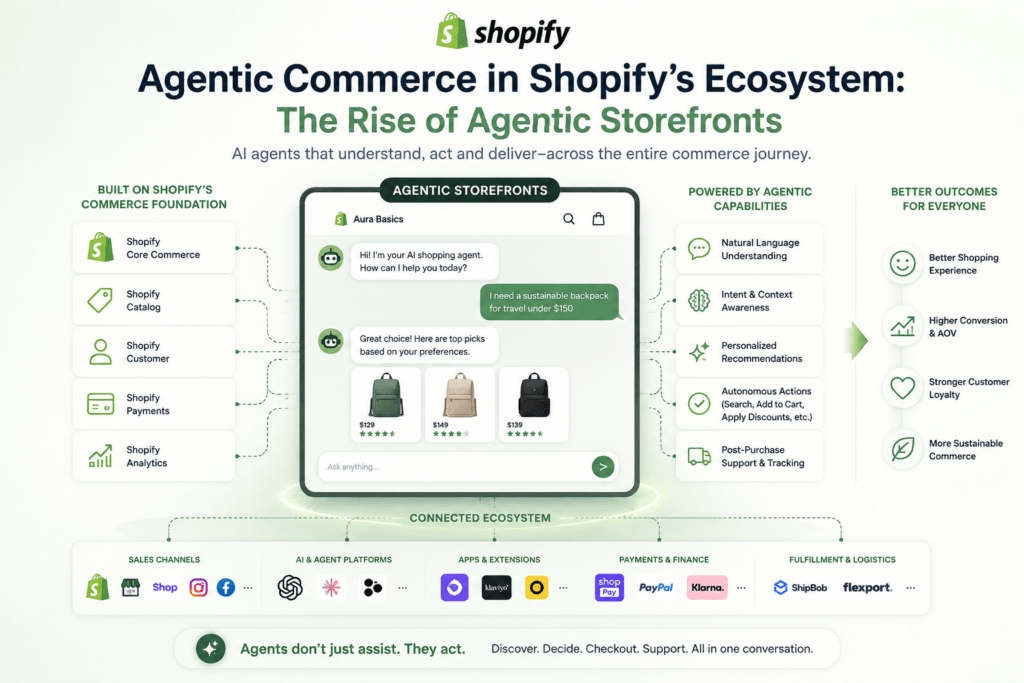
Adobe Analytics measured a staggering 4,700% year-over-year jump in generative AI traffic to US retail sites between July 2024 and July 2025. And on Shopify specifically, the numbers are even more striking: Shopify reports that AI-attributed orders on its platform grew 11x between January 2025 and January 2026.
McKinsey estimates the global agentic commerce opportunity could reach $3 trillion to $5 trillion by 2030. This is not a niche trend. It is the next major platform shift in retail and Shopify is betting its future on being at the center of it.
The Numbers That Signal a Structural Shift
Let’s put some concrete figures around what is happening before we look at the technical details.
Since January 2025, AI-driven traffic to Shopify stores has grown 8 times year over year, while orders from AI-powered searches have increased 15 times. These are not incremental improvements they represent a structural change in how products are discovered and purchased.
Shopify merchants are now discoverable across ChatGPT, Microsoft Copilot, AI Mode in Google Search, and the Gemini app reaching shoppers inside the conversations where they’re already asking for recommendations.
But discovery alone is just one piece of the puzzle. When an AI agent finds the right product, someone still has to verify inventory, calculate tax, process payment, prevent fraud, and fulfill the order. That is the hard part of commerce, and it is what Shopify has spent 20 years building across millions of merchants and billions of transactions.
This is precisely why Shopify is so well positioned for this moment. It already owns the most battle-tested commerce infrastructure on the planet. Now it is making that infrastructure speak the language of AI agents.
The Technical Architecture: UCP, MCP, and Shopify’s Agentic Platform
To understand what Shopify is building, you need to understand three acronyms that are going to define eCommerce for the next decade.
1. UCP — The Universal Commerce Protocol
Shopify announced the Universal Commerce Protocol (UCP) on January 11, 2026 a new open standard co-developed with Google to bring commerce to AI agents at scale.
UCP is an open standard that defines how AI agents transact with merchants covering cart creation, checkout, payment, and post purchase across any platform and any payment processor.
Think of UCP as the common language that allows any AI agent whether it lives inside ChatGPT, Google Gemini, Microsoft Copilot, or a custom enterprise assistant to interact with any merchant’s store in a standardized, reliable way. Without a protocol like this, every AI platform would need a custom integration with every merchant, creating an impossible tangle of bespoke connections.
The backing for UCP is remarkable. UCP is backed by Amazon, American Express, Etsy, Mastercard, Meta, Microsoft, Salesforce, Stripe, Target, Walmart, and Visa. When the biggest names in global commerce align behind a single protocol, it signals that this is not just Shopify’s vision it is the industry’s direction.
UCP is designed to model commerce’s inherent complexity with flexibility in mind. Merchants declare and define what capabilities they support, including their own bespoke functionality. Agents discover these capabilities, negotiate what they can handle, and proceed to complete transactions.
Perhaps the most powerful feature of UCP for merchants is this: when a new AI platform adopts UCP, Shopify merchants are automatically ready to sell there no additional integration required. You integrate once, and you sell everywhere AI conversations happen.
2. MCP — The Model Context Protocol
Model Context Protocol sits beneath both ACP and UCP. MCP is the framework that enables AI agents to query structured, machine-readable information from external systems including inventory, pricing, and checkout logic. Where ACP and UCP define how an agent transacts, MCP defines how the agent gathers the information it needs to decide what to transact for.
In practical terms, MCP allows the merchant to provide the AI agent with “context” about their store live inventory levels, specific shipping rules, or regional pricing without the agent needing to crawl the entire site. This real-time data exchange is what enables the speed and precision required for agentic commerce.
Shopify built its agentic commerce platform on UCP-compliant MCP servers. By Q1 2026, every store had an MCP endpoint live by default. This means that right now, today, your Shopify store already has a machine-readable endpoint that AI agents can query. The question is whether your product data is optimized for them to find you.
3. The Agent Buyer Journey
The agentic commerce flow is a structured sequence, not a free-form interaction. Here is how it works end to end:
1 — Negotiate and Authenticate: Before any shopping happens, an AI agent identifies itself to Shopify via a UCP Profile a document that describes the agent’s capabilities, trust tier, and authentication credentials. This governs what the agent is allowed to do and at what rate.
2 — Product Discovery: The agent queries Shopify Catalog using natural language. Shopify Catalog is the product data layer that feeds AI recommendations across all integrated channels. Shopify Catalog automatically broadcasts product data across all connected AI channels. Orders flow into the store’s admin dashboard with full channel attribution, and the merchant retains full ownership of customer relationships.
3 — Cart and Checkout: Once a product is selected, the agent builds a cart, applies relevant discounts, and creates a checkout. This “Negotiated Checkout” is significantly faster than traditional redirects, often completing in under a second the benchmark for what can be called “Zero-Latency Commerce.”
4 — Orders and Post-Purchase: The agent can subscribe to order webhooks to track fulfillment, answer “Where is my order?” queries, and manage post-purchase flows — all without human intervention.
Agentic Storefronts: What This Means for Every Shopify Merchant
Here is where this shift gets tangible and urgent for store owners.
Think of Shopify’s agentic storefronts as your product catalog, checkout, and brand information packaged so AI platforms can present them natively in a conversation. As of March 2026, agentic storefronts are available to millions of Shopify users.
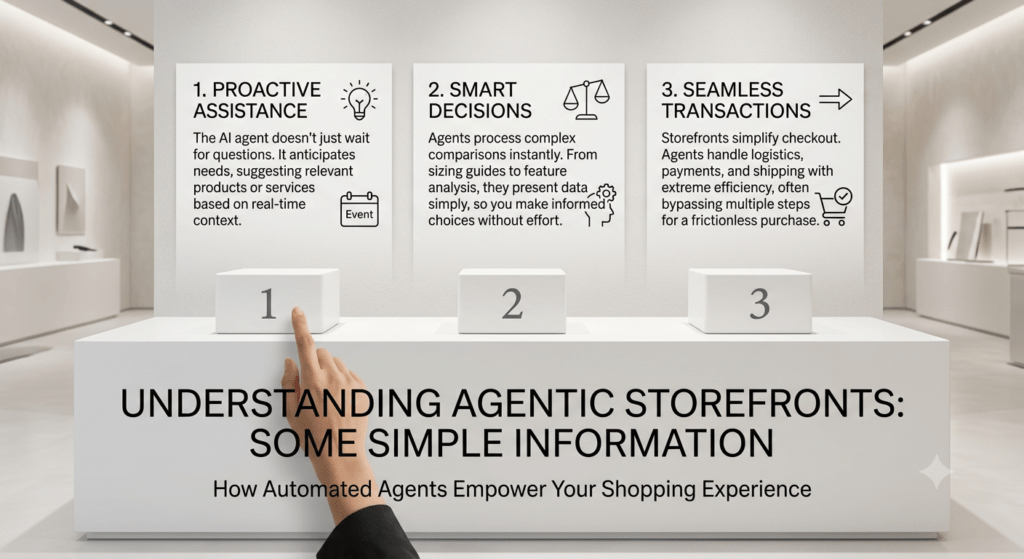
Shopify has announced to merchants that many will be live in AI checkouts by the end of January 2026. Your products can now be sold directly inside AI tools, not just on your site. The checkout experience is handed off, in part, to AI platforms like ChatGPT, Google, and Microsoft.
The store owner stays on as merchant of record with branding and catalog control managed predominantly through their Shopify store. Fees for ChatGPT are to be determined, with Google and Microsoft confirmed to be free at launch.
The implications of this are significant. Google AI Mode and ChatGPT are increasingly behaving like marketplaces surfacing relevant products, content, and promotions to end shoppers, who complete their full purchase within the AI.
This changes the nature of competition. You are no longer just competing for a spot on the first page of Google search results. You are competing for the AI agent’s recommendation. And the criteria are different.
What Changes for Merchants: The New Rules of Discovery
In traditional eCommerce, winning meant having a fast website, great product photography, and a solid SEO strategy. In the agentic era, those things still matter but they are no longer sufficient on their own.
Structured product data matters more than ever. Merchants need machine-readable claims, cleaner product taxonomy, and clear, stable URLs. An AI agent cannot infer that your “midnight navy” jacket is blue, or that your “XL slim fit” shirt is equivalent to a standard large. If your product data is ambiguous or inconsistent, agents will skip your listing for a competitor with cleaner data.
Here is what merchants should prioritize:
Audit Your Structured Data Your product titles, descriptions, metafields, and variant options need to be clear, consistent, and machine-readable. Size, color, material, weight, dimensions every attribute that a human buyer might ask about should be explicitly declared in your product data, not buried in a description paragraph.
Move Marketing Claims Into Metafields If a product is “waterproof,” “hypoallergenic,” or “made in Italy,” those claims should live in structured metafields, not just in marketing copy. AI agents query structured data, not unstructured prose. If your key selling points are not in the right fields, agents will not surface them.
Ensure Your Checkout Is Modern and Compatible Adopting modern checkout and UCP-compatible agent-facing protocols is a concrete action merchants should take in 2026. If you are still on a heavily customized legacy checkout that does not support Shopify’s standard APIs, you may find yourself excluded from agentic flows.
Optimize for “Agent Intent,” Not Just Search Intent Traditional SEO optimizes for what humans type into search bars. Agentic optimization means structuring your catalog around the kinds of goals AI agents receive: “Find a gift under $50 for a 7-year-old who likes dinosaurs,” or “Order running shoes that arrive within two days.” Think in terms of use cases and outcomes, not just keywords.
Consider the Post-Purchase Experience This is the unsolved problem in agentic commerce: an AI agent places the order, not the customer. When that customer wants to change the order an hour later, the normal post-purchase flow does not exist. This is a merchant problem, not a Shopify one. Think carefully about how you handle order modifications, cancellations, and support for agent-placed orders.
The Competitive Landscape: ACP, UCP, and the Protocol Wars
Shopify and Google’s UCP is not the only agentic commerce protocol. The landscape is more complex and merchants should understand what they are participating in.
ACP (Agentic Commerce Protocol) is the open standard co-developed by OpenAI, Stripe, and Meta that powers ChatGPT Instant Checkout. UCP is the open standard co-developed by Google and Shopify that powers commerce inside Google AI Mode and Gemini. MCP is the underlying framework that enables AI agents to query structured information from external systems. Together, these three protocols form the technical foundation of agentic commerce.
Most enterprise merchants will need to support more than one protocol rather than choosing between them. For Shopify merchants, this is largely handled automatically Shopify’s platform participates in both ACP (via its ChatGPT integration) and UCP (via its Google partnership), abstracting the protocol complexity away from the merchant.
The fact that all of these major protocols backed by OpenAI, Google, Shopify, Stripe, Visa, Mastercard, Walmart, and dozens of others are converging on the same agentic commerce model in the same 12-month window is a strong signal that this is not a passing trend. This is the infrastructure being laid for the next decade of retail.
What Shopify Is Building Beyond the Protocol
UCP and MCP are the foundational layer. But Shopify is building an entire ecosystem on top of them.
Shopify Catalog is the product data broadcast system that feeds AI recommendations across all integrated channels. When your store is part of Shopify Catalog, your products are eligible to be surfaced by any AI agent that queries the catalog — whether that is Google Gemini, ChatGPT, or a third-party shopping assistant.
The Shopify AI Toolkit is a set of developer tools, CLI utilities, and plugins that make it practical to build custom AI agents and commerce workflows. It includes the UCP CLI for querying merchant capabilities and running agent flows, and integrates with Claude, Cursor, Gemini, and other AI development environments.
Agentic Storefronts is the merchant-facing layer — Shopify is activating Agentic Storefronts for all stores in 2026, and as of late March 2026, Shopify is activating them by default for every store on the platform. This means every Shopify merchant becomes, by default, accessible to AI shopping agents.
The Shopify Agentic Plan extends this reach even further: the Shopify Agentic Plan lets brands on any eCommerce platform list their products in the Shopify Catalog and sell through agentic storefronts meaning merchants not on Shopify can still participate in its agentic commerce network.
The Developer Opportunity: Building Agentic Commerce Apps
For developers and agencies, this shift represents a significant new opportunity.
The agentic commerce stack creates demand for a new category of applications: AI shopping assistants scoped to a single merchant, cross-merchant discovery agents, post-purchase automation tools, and enterprise procurement agents that source from multiple Shopify stores.
Shopify’s developer documentation outlines the key building blocks:
A Catalog MCP Server enables natural language product search across a merchant’s catalog. A Cart and Checkout MCP Server allows an agent to build and modify carts and hand off to checkout. An Order MCP Server enables agents to track, modify, and manage fulfillment. And an Agent Profile hosted at a stable URL and referenced on every UCP request governs authentication, trust tier, and capabilities.
Already, 3–8% of sessions on stores with high visibility in ChatGPT-sourced shopping are arriving via agent referrals. By Q4 2026, most consumer-facing AI assistants are expected to have commerce integrations.
For agencies building on Shopify, advising clients on agentic readiness structured data audits, MCP endpoint testing, agent profile setup, and post-purchase flow design for agent-placed orders is rapidly becoming a core service offering.
Preparing Your Store: A Practical Checklist for 2026
Whether you are a merchant, a developer, or an agency, here is a concrete starting point:
1. Enable Shopify Catalog and verify your products are eligible for AI channel discovery
2. Check your Admin dashboard for the agentic storefront notification and review your channel settings under Settings > Sales Channels
3.Audit product data quality — ensure all key attributes (size, color, material, features, use case) are in structured fields, not buried in descriptions
4.Review your checkout setup — confirm compatibility with Shopify’s standard checkout APIs and UCP flows
5. Design a post-purchase edit flow for orders placed by agents, not directly by customers
6. Test your store’s MCP endpoint using a dev store and the Shopify AI Toolkit
7. Think about your brand positioning in natural language — how would you want an AI to describe and recommend your products?
The Bigger Picture: Why This Matters Beyond Shopify
While it is tempting to frame this as a Shopify story, but the deeper shift is about the nature of the internet itself.
For 30 years, the web has been built for human eyes. Every design decision navigation menus, product image carousels, hero banners, checkout flows has been optimized for human cognition and human behavior. AI agents do not need any of that. They need structured data, machine-readable APIs, and reliable protocol interfaces.
The stores that will win in the next phase of eCommerce are not necessarily the ones with the best-looking websites. They are the ones with the cleanest data, the most reliable APIs, and the fastest, most frictionless transaction flows.
Shopify has spent two decades building exactly that kind of infrastructure.
Shopify is building commerce infrastructure wherever AI conversations happen.
From Catalog to Checkout to Agentic Storefronts — every layer is built for the agent era.
Final Thoughts
The shift to agentic commerce is not something that will happen someday. Consequently, it is happening now, at a pace that is accelerating every quarter. Merchants who wait will fall behind AI agents are already favoring stores with clean data, fast checkouts, and reliable fulfillment.
Shopify aims to be the commerce layer of the AI internet — just as it was for the social media era.
The shift to agentic commerce mirrors mobile in 2010 and social in 2015.
The only question is: how quickly will you adapt?
The infrastructure is ready. The protocols are live. The AI agents are already shopping. Is your store ready to be found?