The Tale of Two Platforms Shopify vs Amazon
Shopify vs Amazon
September 8, 2026, was supposed to be Meta’s triumphant debut of Muse, its new personal AI agent. But by September 20, the narrative had fractured into two completely different stories depending on which e-commerce platform you visited which is Shopify vs Amazon.
On one side: Amazon erected digital walls against Meta’s agent, blocking Muse from accessing its marketplace and citing unauthorized access, security concerns, and data governance violations. The message was clear and unambiguous—agents weren’t welcome.
On the other side: Shopify’s CEO Tobi Lütke announced the exact opposite. “Partnering deeply with Muse to enable agentic checkout with Shop Pay on all Shopify stores,” he wrote. Within hours, Mark Zuckerberg replied with enthusiasm: “Teaming up with Shopify to make shopping and checkout easier in Muse. Shoppers find more. Shops sell more.”
In less than two weeks, Meta’s Muse became the #1 free app in Apple’s US App Store beating ChatGPT. Yet it was simultaneously banned from the world’s largest e-commerce platform while gaining unrestricted access to millions of Shopify stores.
This isn’t a coincidence. It’s a strategic divergence that reveals fundamentally different business philosophies, market positions, and long-term visions for how AI will reshape commerce. Understanding this divide is essential for merchants, investors, and anyone building in the agentic commerce space.
The Business Models Behind the Strategies
To understand why Shopify vs Amazon responded so differently to Muse, you need to understand how they make money. Their revenue models couldn’t be more different and those differences explain everything.
Amazon’s Money: Marketplace Control and Advertising
Amazon’s core business model has evolved significantly over the past decade. While logistics and retail still matter, the real profit engine is now advertising and seller services. In 2025, Amazon generated more than $68 billion in advertising revenue a business that depends entirely on Amazon controlling the visibility funnel.
Here’s the problem Muse creates: When an AI agent searches Amazon’s catalog and makes purchasing decisions autonomously, it bypasses the entire ad impression flow. Sellers don’t get sponsored product placements. Amazon’s recommendation algorithm doesn’t influence the purchase. The agent selects products based on its own logic, not based on who paid for visibility.
For a $68 billion advertising business, this represents an existential threat. Amazon’s dominance isn’t just about scale anymore—it’s about controlling the discovery path. Autonomous agents that decide what to buy without browsing Amazon’s carefully optimized storefronts undermine that control.
Additionally, Amazon derives revenue from seller services: fulfillment, storage, and advertising. Each of these depends on merchants relying on Amazon as their primary customer acquisition channel. Agents that let customers shop across multiple retailers reduce that dependency.
Shopify’s Money: Merchant Enablement and Payments
Shopify operates from a fundamentally different position. The company doesn’t own inventory. It doesn’t compete with its merchants. Instead, Shopify makes money by enabling merchants to sell more effectively across all channels—and by capturing a portion of the transaction value through payments processing.
Shopify’s revenue comes from three sources: platform fees (a percentage of merchant sales), payment processing, and add-on services (apps, themes, consulting). The company has no interest in controlling the customer acquisition path. In fact, Shopify benefits when merchants access their stores through ANY channel—Google, Pinterest, social media, or now, AI agents.
More importantly, Shopify has been building toward embedded finance and checkout services as a core differentiator. Shop Pay—Shopify’s one-click checkout—has facilitated over $24 billion in orders. The company views Shop Pay as a competitive moat: it’s fast, it converts customers, and it keeps transaction data within Shopify’s ecosystem.
When Muse arrives as a new customer acquisition channel, Shopify wins on multiple fronts. Merchants get discovered by a new audience. The transaction happens through Shop Pay, generating payment processing fees. And Shopify gains strategic leverage with Meta—a company that could become a serious competitor if it decides to build its own merchant platform.
The Strategic Insight: Shopify benefits from distributed customer acquisition. Amazon needs centralized control. These are incompatible with how each company generates profit, which is why they made opposite decisions within the same week.
Philosophies: Agents as Customers vs. Agents as Trespassers
The Shopify vs Amazon divide also reflects different philosophies about what an AI agent actually is.
Amazon’s View: Unauthorized Access
Amazon explicitly framed Muse as unauthorized access that violates its Terms of Service. The company’s position: if Meta wants to let customers shop on Amazon through Muse, Meta needs to ask permission first. The agent doesn’t identify itself as an agent. It doesn’t declare its origin. It appears to Amazon as just another browser session, but without human intent or acknowledgment.
From Amazon’s perspective, this is trespassing. It’s similar to a data scraper automatically extracting product information without permission. The terms of service state that Amazon controls access to its platform. By using Muse to shop on Amazon without explicit authorization, Meta is technically violating those terms.
Additionally, Amazon views agents as threats to customer experience. If a customer’s agent makes a purchase mistake, Amazon’s customer service team has to resolve it. If agent behavior becomes unpredictable, Amazon’s fraud systems get overwhelmed. The company didn’t invite these operational burdens.
Shopify’s View: Agents as Customers
Shopify’s positioning was completely different. The company saw Muse not as a trespasser, but as a new customer segment. According to Rohit Mishra, Shopify’s VP of Product, “Agentic commerce really excites us. The agents don’t have the same challenges as humans. The AI agents have more context and they can find more products much faster.”
This framing treats agents as legitimate participants in the marketplace—customers with different properties than humans, but customers nonetheless. They have intentions (find a product that matches X criteria), they have preferences (prioritize certain brands or features), and they execute transactions. Why shouldn’t they be welcome?
Shopify’s approach is also more pragmatic. Rather than fighting against Muse, Shopify negotiated an integration that serves both parties. Merchants get access to a new discovery channel. Muse gets reliable checkout through Shop Pay. Shopify gets transaction fees and data about agent-driven behavior.
The difference: Shopify doesn’t rely on advertising revenue or seller service fees that depend on controlling the customer acquisition funnel. Therefore, Shopify benefits from openness. Amazon’s business model requires control, so Amazon chooses restriction.
Shop Pay: The Enabler That Separates Winners from Losers
The Shopify-Muse integration hinges on one critical piece of infrastructure: Shop Pay. This isn’t an accident. Shop Pay is the reason Shopify can embrace agentic commerce where Amazon must restrict it.
What Shop Pay Does
Shop Pay is a one-click checkout service that stores customer payment credentials and shipping information. When a customer checks out with Shop Pay, there’s no form-filling, no address entry, no payment card details. It’s instant. And critically, Shop Pay credentials are portable across all Shopify stores—a network effect that grows stronger with every participating merchant.
For Muse, Shop Pay is ideal. The agent can access the stored Shop Pay credentials (without seeing the actual payment card or password) and complete purchases instantly across any Shopify store. No credential sharing required from customers. No security concerns about Muse storing Amazon login information. The agent authenticates through Shop Pay, which handles the security layer.
According to Shopify’s announcement, Muse can now search the Shopify Catalog for matching products and complete purchases directly in the Muse app using Shop Pay. It’s a seamless experience that doesn’t require customers to visit a website or enter credentials.
Why Shop Pay Matters Strategically
Shop Pay transforms Shopify’s position in the agentic commerce era. Consider what Amazon lacks: an equivalent payment infrastructure that works across merchants and can safely authenticate AI agents without credential sharing.
Amazon One was Amazon’s biometric payment play, but it never achieved meaningful adoption. it exists but is primarily a merchant payment processor, not a unified wallet like Shop Pay. Amazon doesn’t have a “stored credential network” that spans thousands of merchants and can instantly authenticate agents.
This means if Amazon wanted to embrace agentic checkout, it would need to ask customers to share Amazon login credentials with Muse (exactly what Shopify avoided). That creates the security concern Amazon cited in its blocking decision.
Conversely, Shopify’s Shop Pay infrastructure directly enabled its ability to partner with Muse safely and quickly. The company had already built the payment rails that agentic commerce requires. It was a natural fit to open those rails to agents.
This has a deeper implication: companies that invested in modern payment infrastructure earlier (Shopify, Stripe, Payment networks) are better positioned to participate in agentic commerce. Companies that relied on older models (direct credential handling, password authentication) face a choice between blocking agents or building new infrastructure from scratch.
The Broader Ecosystem Strategy
Amazon’s decision to block Muse wasn’t made in isolation. It reflects Amazon’s broader defensive stance toward third-party AI access to its retail infrastructure.
Amazon’s history with Perplexity showed this pattern. When Perplexity’s Comet browser agent shopped on Amazon without permission, Amazon pursued legal action. Though the court ultimately ruled against Amazon on jurisdictional grounds, Amazon still blocked the agent at the platform level.
Amazon’s strategy: maintain exclusive control over how its platform is accessed. No third-party agents. No external intermediaries. Only Amazon’s own Alexa and proprietary AI systems get special access.
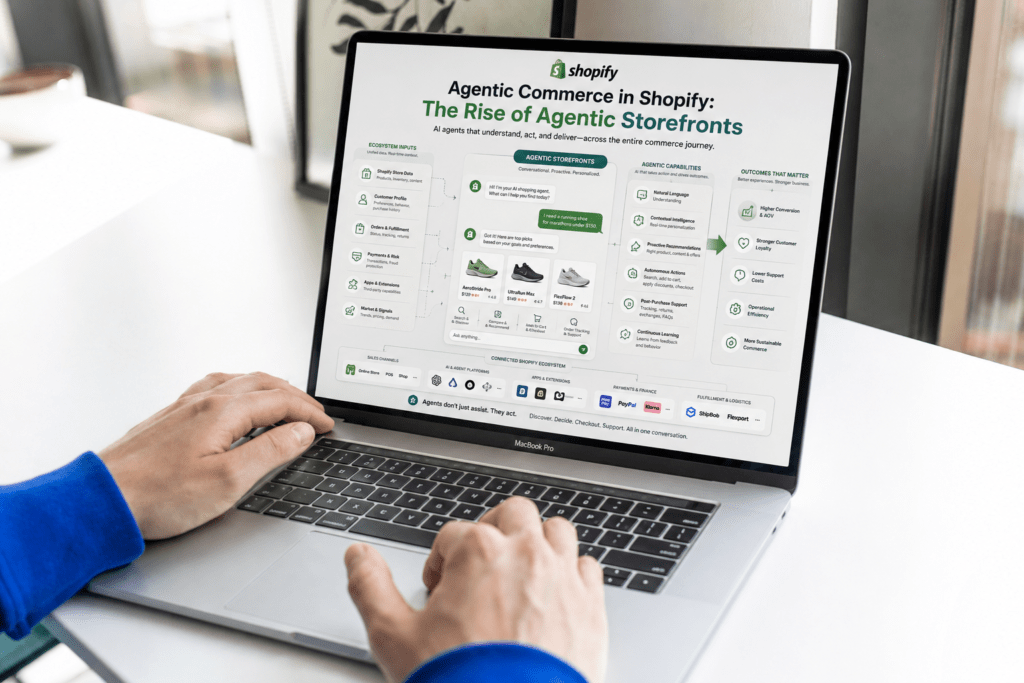
Shopify, by contrast, is embracing an open ecosystem. The company participated in developing Google’s Universal Commerce Protocol—a set of standards designed to let AI agents complete purchases across multiple retailers. Shopify is also partnered with OpenAI, allowing ChatGPT users to shop Shopify merchants through direct checkout. And now Muse integration adds Meta to the mix.
Shopify’s strategy: become the platform of choice for merchants who want access to every customer acquisition channel imaginable. Whether customers arrive via Google, ChatGPT, Muse, or any future agent, Shopify wants to serve that transaction.
This strategic difference extends beyond commerce. Shopify is positioning itself as infrastructure for distributed retail. Amazon is positioning itself as a closed ecosystem that extracts maximum value from control. Both strategies are rational given their business models—but they point to very different futures.
Market Signals and Merchant Implications
The divergence between Shopify vs Amazon has immediate implications for merchants.
For Amazon Sellers: No Muse Traffic, At Least for Now
Amazon sellers don’t have the option to opt-in to Muse traffic. Amazon made the decision unilaterally. Sellers can’t choose whether to be available to agents; they’re blocked by default.
This has downstream consequences. As Muse grows and becomes the primary way consumers discover products, Amazon sellers lose access to a customer segment. Shopify merchants, meanwhile, capture that traffic by default. Within a year, if agentic commerce gains mainstream adoption, Shopify merchants could see material traffic and revenue uplift from Muse and other agents. Amazon sellers see nothing.
That said, Amazon’s block might not be permanent. If Amazon eventually negotiates a whitelisting agreement with Meta, the company might require concessions—higher fees, product data sharing, or other commercial terms. Shopify negotiated without such apparent leverage loss, which suggests Shopify had more motivation to integrate quickly.
For Shopify Merchants: Automatic Discovery, No Action Required
Shopify merchants’ products are discoverable through Muse by default. No opt-in required. No additional setup needed (though catalog quality improvements help). This is significant because it means merchants get access to a new customer segment without any friction.
However, merchants need to be aware of implications. Agent-driven traffic behaves differently than organic or paid traffic. Agents tend to focus on objective criteria: lowest price, highest rating, specific features. This could shift purchase patterns and put downward pressure on margins if merchants aren’t competitive on fundamentals.
Additionally, attribution becomes complex. If a Muse agent refers an order, how does the merchant track it? Google Analytics and custom pixels don’t fire in Meta’s direct checkout. Shopify says it sends server-to-server events, but merchants need to configure their analytics properly or they’ll lose visibility into agent-driven sales.
The Broader Market Signal
Shopify’s decision to embrace Muse is being read as validation that agentic commerce is viable. McKinsey estimates that AI-mediated search and purchase automation could reach $1 trillion in annual US retail revenue by 2030. If even a fraction of that goes through agents, the platforms that support agent access will capture more transaction volume and data.
Market data supports this. Muse became the #1 free app on Apple’s App Store within a week of launch—beating ChatGPT, Instagram, and TikTok. It was the most downloaded app in its category and the fastest-growing AI agent in the market. Those download numbers suggest real consumer demand for autonomous shopping.
Investors noticed. Meta’s stock rose 11% when the Amazon block was announced. The market interpreted Amazon’s blocking as a sign of Muse’s threat level—and threat level is proportional to opportunity size.
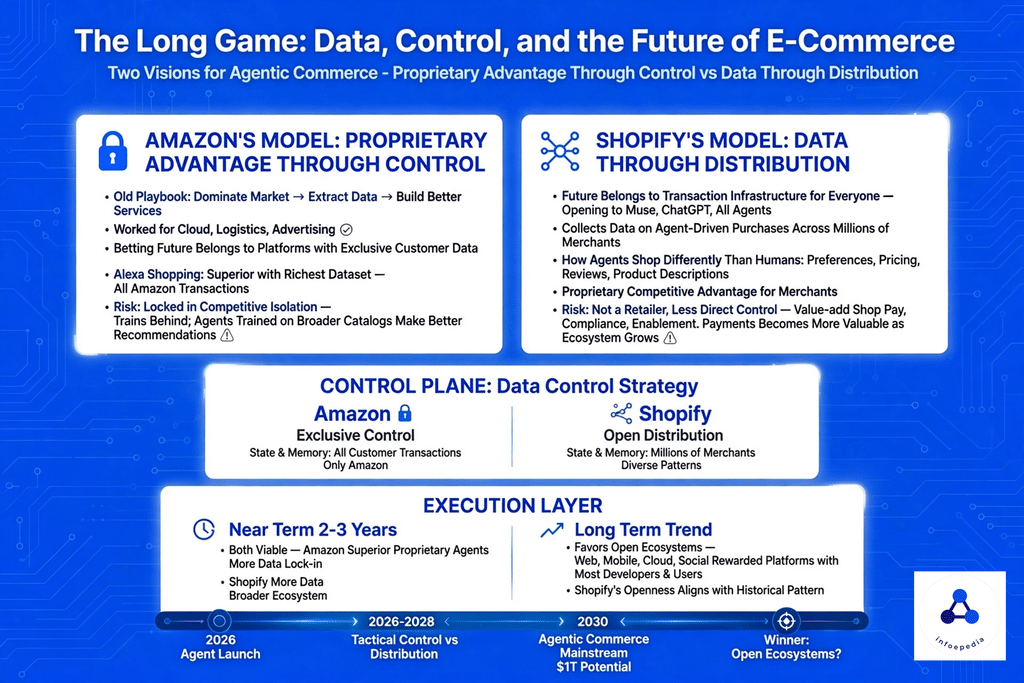
The Long Game: Data, Control, and the Future of E-Commerce
Beyond immediate tactical concerns, the Shopify vs Amazonsplit reflects different visions for what e-commerce becomes in an agentic world.
Amazon’s Model: Proprietary Advantage Through Control
Amazon is betting that the future of commerce belongs to the platforms that build their own AI agents and maintain exclusive control over customer data. By blocking third-party agents, Amazon preserves its ability to build Alexa shopping experiences that are superior because they have access to the richest dataset—all customer transactions on Amazon.
This is the old Amazon playbook: dominate a market, extract data from that dominance, and use that data advantage to build even better services. It worked for cloud computing, for logistics, and for advertising. Amazon believes it will work for agentic commerce too.
The risk: if other platforms (Shopify, retailers with their own platforms) capture agentic commerce traffic while Amazon is locked in competitive isolation, Amazon might train behind in agent quality. Agents trained on broader merchant catalogs and diverse transaction patterns might make better recommendations than Amazon Alexa trained only on Amazon transactions.
Shopify’s Model: Data Through Distribution
Shopify is betting on the opposite: that the future belongs to platforms that become transaction infrastructure for everyone. By opening to Muse, ChatGPT, and other agents, Shopify collects data on agent-driven purchases across millions of merchants and products.
This data tells Shopify how agents shop differently than humans. What agent preferences are. How agents respond to pricing, reviews, product descriptions. Over time, that becomes proprietary competitive advantage not for Shopify directly, but for the merchants and services Shopify builds on top of it.
The risk: Shopify isn’t a retailer, so it has less direct control over customer relationships. If Meta or Google decide to integrate directly with merchants, Shopify becomes a middleman. But the counter-argument is that Shopify’s value-add—Shop Pay, compliance, merchant enablement, payment processing—becomes more valuable as the ecosystem grows.
The Verdict (For Now)
In the near term (next 2-3 years), both strategies seem viable. Amazon’s control gives it the ability to build superior proprietary agents. Shopify’s openness gives it more data and a broader ecosystem of partners. Which strategy wins depends on whether agentic commerce becomes mainstream and how regulation evolves.
But in the long term, the trend appears to favor platforms that support open ecosystems. Every major technology transition—from the web to mobile to cloud to social rewarded platforms that attracted the most developers and users. Shopify’s openness aligns with that historical pattern.
FAQs: Shopify, Muse, and Strategic Platform Choices
Q: Why did Shopify vs Amazon make opposite decisions about the same AI agent?
A: Shopify vs Amazon business models are fundamentally different. Amazon makes money from advertising and seller services that depend on controlling how customers discover products. Shopify makes money from payments processing and merchant enablement, which benefit from diverse customer acquisition channels. Amazon’s control-based model requires blocking external agents. Shopify’s distribution-based model requires enabling them.
Q: Can Shopify merchants opt out of appearing in Muse?
A: Yes. Shopify allows merchants to toggle off Agentic Storefronts settings, which controls which channels can access their catalogs. However, Shopify’s default is to enable catalog sharing, so merchants need to actively opt out if they don’t want Muse to access their products.
Q: Will Amazon eventually negotiate with Meta the way Shopify did?
A: Possibly. Shopify vs Amazon Meta have commercial relationships outside e-commerce. If Muse becomes sufficiently important, Amazon might negotiate terms but from a position of strength, likely requiring concessions from Meta on data sharing, fees, or operational controls that Shopify didn’t have to make.
Q: How does Shop Pay enable Shopify’s strategy in a way Amazon can’t replicate?
A: Shop Pay is a portable, stored-credential payment system that works across all Shopify merchants without requiring password sharing. When Muse accesses Shop Pay, it can authenticate and complete purchases without seeing customer passwords. Amazon lacks an equivalent system, which means Amazon would need customers to share Amazon login credentials with Muse creating the security concern Amazon cited in its block.
Q: Will agentic commerce really grow to $1 trillion as McKinsey predicts?
A: That’s speculative, but the market signals are positive. Muse became the #1 free app within a week. Only 16% of shoppers are currently comfortable with AI agents completing purchases, but comfort adoption curves upward as people experience successful transactions. If agent shopping moves from 16% to even 30% of the market, the revenue impact would be enormous.
Q: Which strategy—Amazon’s control or Shopify’s openness—will ultimately win?
A: Neither may “win” in absolute terms. Amazon will likely build superior proprietary agents because it has more data and customer lock-in. But Shopify and open platforms will capture higher growth and more merchant adoption. The market will bifurcate: loyal Amazon customers use Alexa shopping; everyone else shops through agents on Shopify-powered stores. Both can be profitable.
Q: What should merchants do in light of this divergence?
A: If you’re on Shopify, optimize your product catalog for agent discovery (clear titles, complete descriptions, accurate attributes). If you’re an Amazon seller, focus on Alexa and proprietary channels while waiting to see if Amazon negotiates with Meta. If you operate on both platforms, invest in the Shopify side of the business, where agentic commerce is explicitly enabled.
Conclusion: Two Paths, Same Destination, Different Timelines
The Shopify vs Amazon divergence on Meta’s Muse isn’t a disagreement about whether agentic commerce is real. Both companies recognize the opportunity. It’s a disagreement about the path to capturing that opportunity.
Amazon believes the path goes through proprietary control building exclusive AI experiences that only work well on Amazon because they have exclusive data. Shopify believes the path goes through distribution becoming the payments and fulfillment infrastructure that serves any customer acquisition channel, including agents.
For the next few years, Amazon’s strategy might look smarter. Alexa shopping will improve faster than general-purpose agents because Amazon has more data. Amazon will extract more revenue per transaction because it owns the entire stack. Shopify might appear to lose if Muse and other agents take traffic without Amazon equivalents.
But by 2030, the picture might reverse. If agentic commerce reaches McKinsey’s $1 trillion estimate, the platforms that captured market share early (Shopify with Muse integration) will have data advantage that creates positive feedback loops. Merchants that saw success through agents will deepen their Shopify commitment. Customers that get used to shopping through Muse will continue to do so.
Meanwhile, Amazon sellers locked out of agent distribution will face pressure to diversify away from Amazon. Some will move to Shopify. Others will invest in DTC channels. Amazon’s market share in e-commerce might stay high, but its rate of growth could slow relative to competitors that participated in agentic commerce early.
The irony: Amazon’s decision to block Muse as a defensive move might ultimately put Amazon at a strategic disadvantage. By ceding agentic commerce to Shopify vs Amazon left itself on the wrong side of the technological transition. That’s the real story behind the Muse blocking not a tactical win, but a strategic vulnerability dressed up as a security concern.