Agentic AI for Small Business: A Week in the Life of a Store With Three Agents
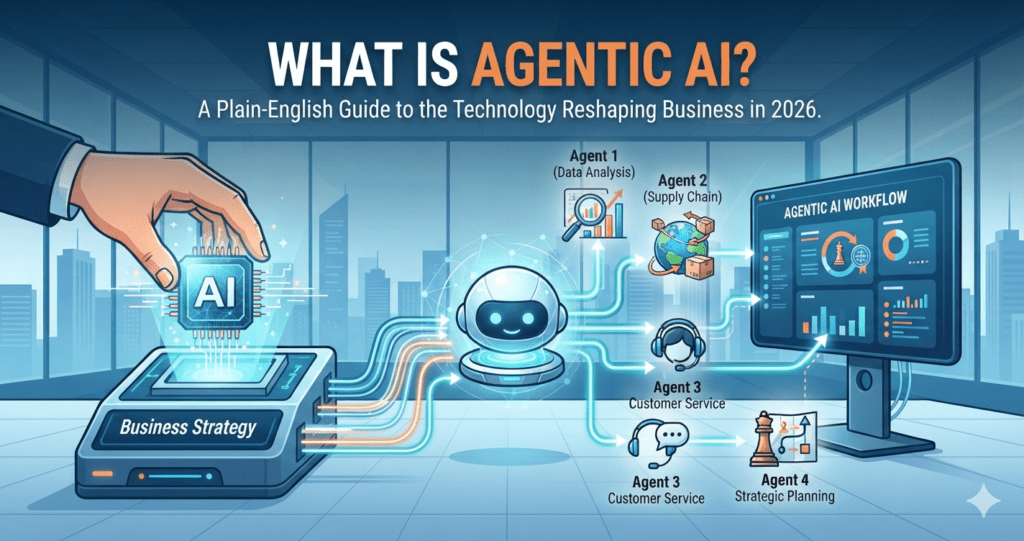
For a small business, agentic AI means a few narrow software helpers that each own one chore from start to finish: they read the request, use your tools, make the change and tell you what they did. They aren’t robots running the company. Think of them as new part-time staff who never sleep and still need a manager.
Most explanations of agentic AI stay abstract. So let’s make it concrete. Picture an online shop with ten people, a Shopify or WooCommerce store, a shared inbox and a weekly spreadsheet nobody enjoys building. (This is an illustration, not a client story.) Here’s what a week looks like once three agents are doing the dull parts.
Monday: the support agent clears the inbox
Over the weekend 60 messages arrived. Most ask where an order is. The support agent reads each one, looks up the order in the store admin, checks the carrier’s tracking page and replies with the real status. Anything involving a refund above a set amount, an angry customer or a damaged item goes into a “needs a human” queue with a summary attached.
On Monday morning the team opens a short queue instead of a full inbox. That is the pattern to remember: the agent handles the routine cases and passes up the exceptions with context.
Wednesday: the catalogue agent fixes product pages
A supplier sends a spreadsheet of 40 new items. The catalogue agent reads it, writes titles and descriptions in the store’s style, fills in size and material fields, flags rows with missing data and drafts the products as unpublished. A person approves them in ten minutes.
Nothing goes live without approval. Draft first, publish second is a sensible rule for any agent that touches your public site.
Friday: the reporting agent writes the summary
Every Friday the reporting agent pulls sales, ad spend and search data, compares them with last week and writes five plain sentences: what rose, what fell, and one thing worth investigating. Four hours of spreadsheet work becomes a short read.
What connects these agents to your tools?
Two open standards do most of the plumbing, and both now live under the Linux Foundation’s Agentic AI Foundation. The Model Context Protocol (MCP) gives an agent hands: a standard way to read data and use tools such as your store, calendar or database. Agent2Agent (A2A) lets agents from different vendors talk to each other. Version 1.0 of A2A was frozen on 12 March 2026, and the project joined the Foundation on 17 August 2026. Our MCP guide explains the first in depth.
What does this story leave out?
The tidy version hides real risks. Gartner expects more than 40% of agentic AI projects to be cancelled by the end of 2027 because of cost, unclear value or weak risk controls, and it has warned about “agent washing”, where old chatbots get a new label. McKinsey’s late-2025 survey found 62% of organisations experimenting with agents but only 23% scaling them anywhere, and no more than about 10% in any single function.
Translation: the technology works on narrow jobs, and the gap between a demo and a dependable system is where projects die.
Five questions to ask before you buy anything called an “agent”
- What exact task does it own? If the answer is “everything,” walk away.
- What can it change without asking? Look for read-only modes, spending caps and draft states.
- Where does a human step in? Ask to see the escalation path.
- Can I see what it did? You need logs you can actually read.
- How will we measure it? Hours saved, errors per hundred tasks, cost per ticket. Agree the number first.
FAQ
What can an AI agent do for a small business?
Handle repetitive, rules-based work across your tools: answering order questions, updating listings, drafting reports, qualifying leads.
How much does it cost to start?
Usually a workflow tool, a language model subscription or API usage, and some setup time. Start with one workflow so the spend stays small and measurable.
Do I need a developer?
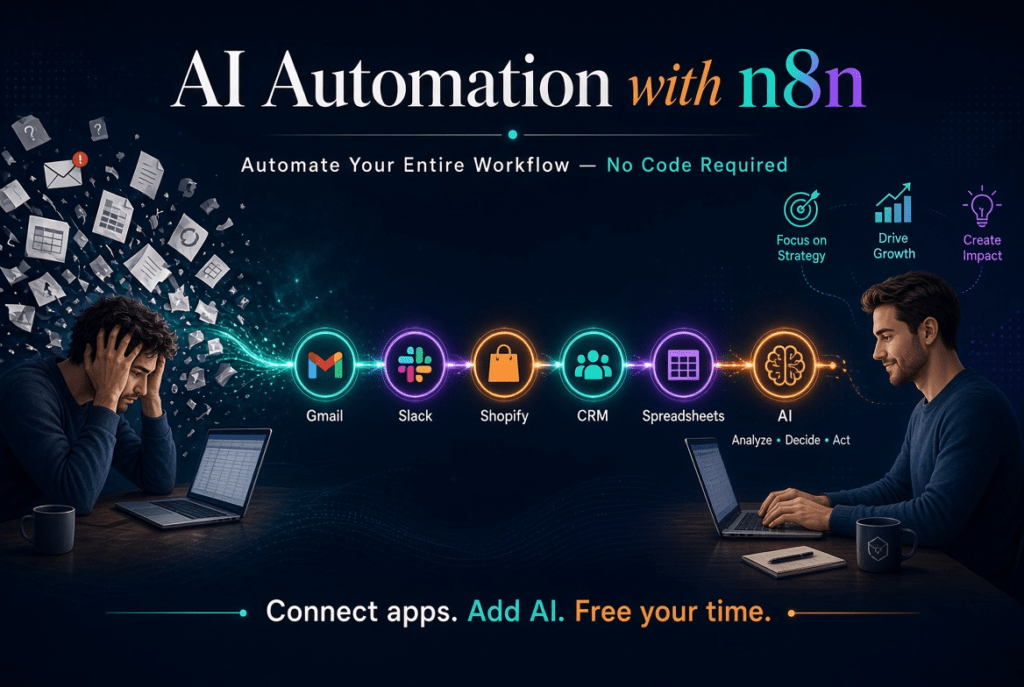
For a first agent, often no. Visual builders such as n8n help, and our n8n guide shows how. For anything touching payments or customer data, get technical review.
Is agentic AI different from automation?
Yes. Automation follows fixed rules. An agent chooses the next step based on what it finds.